
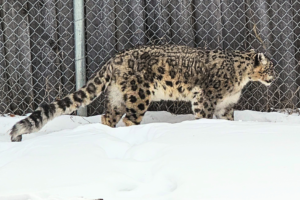
In all my years in Toon Town, my January outing at the Saskatoon Zoo was my first winter visit. A couple of my friends joined me for what I imagined would be a walk around a beautiful landscape but without much animal action. I was wrong. There are plenty of animals that prefer winter. Can you imagine having a full coat of fur in the summer and then even more fur in the winter? Which season would you prefer? I have never seen the snow leopard before when it wasn’t hidden in the shade. This time, it was right there in full view. What a beautiful sight!
Kazi is a male snow leopard living in the Nutrien Ark habitat. From what I have read, he sometimes likes to lie on his back in the snow to relax, or shall we say ‘chill out’. Snow leopards are a vulnerable species, so Kazi is part of the international conservation efforts. The Saskatoon Zoo is participating in the Association of Zoos and Aquariums (AZA) Species Survival Plan (SSP) program.
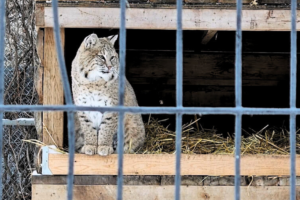
There are lots of animals who do well in the winter at the Zoo, including Pallas’s cats, Arctic wolves, a Canada lynx and two bobcats. The City’s website says lynx paws act as natural snowshoes for walking on deep snow. The Saskatoon Zoo’s lynx is also part of the AZA Species Survival Plan program. I have no picture of the lynx though, because when I was looking at the pictures I took, I thought the picture below was a lynx. When I realized I might be mistaken, I checked different websites and I still wasn’t sure, but I am 95% sure this picture is a bobcat. If I could see the tail or a different view of this feline, it would be an easier guess. The two can look similar, but there are no big ear tufts on this one, just tiny ones when you zoom in on a full-sized picture.
So, about the bobcats: There are two of them – brothers named Sherlock and Watson, and they too were brought in as part of the Species Survival Plan program. They will be six this year.
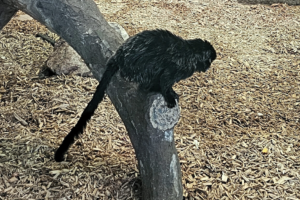
To warm up a bit, we checked out the Small Mammal House. On the bottom floor, you’ll find African crested porcupines, Ring-Tailed lemurs, Goeldi’s monkeys and meerkats. I have a habit of highlighting the lemurs and meerkats in my blogs because they aren’t as shy for taking pictures, and they are too cute. But this time I got a picture of a Goeldi’s monkey. They live mostly in the upper Amazon basin of Bolivia, Brazil, Columbia and Peru. Not including their tail, a Goeldi’s monkey is about 8 to 9 inches or 21 to 23 centimetres. (I still measure in inches and feet, but because of driving, I am more inclined to use kilometres, much like many of us older Canadians!) Their tails are typically longer than their bodies at around 10 to 13 inches, or 25 to 32 centimetres long. BTW, I looked it up to make sure. Goeldi’s is pronounced GELD eez. I thought it might be Goldy’s, so I had to find out. It was driving me crazy not knowing for sure, every time I went to the Zoo. However, I will probably have forgotten by next month anyway. LOL
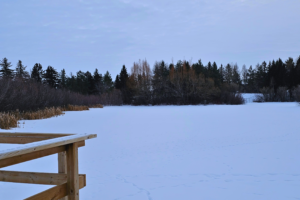
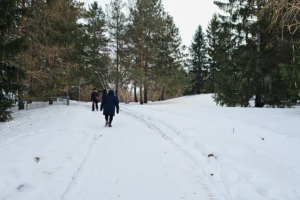
As I mentioned at the beginning, I figured the landscape would be picturesque and I was not wrong. It was about -20C with the windchill, so a bit crisp, but we had just had that cold spell which toughened us up. We went to the pier for the view and I love the trees throughout the park.
If you are up for a winter adventure, I suggest you check out the Saskatoon Zoo. Admission is by donation through to the end of April. It’s open 10 a.m. to 4 p.m. daily. Forestry Farm Park hours in the winter are 7:30 a.m. to 4:30 p.m. through April 14th. And my final message, if you appreciate the Zoo, you know what to do! With your help, the Saskatoon Zoo Foundation raises funds for capital projects to improve the lives of the animals that live there. The biggest project right now is raising funds for a larger space for Koda and Mistaya, the Zoo’s two grizzly bears who were rescued separately as cubs. Click here to donate: Donate – Saskatoon Zoo Foundation
Your Saskatoon Zoo Foundation Blogger,
Carol Thomson